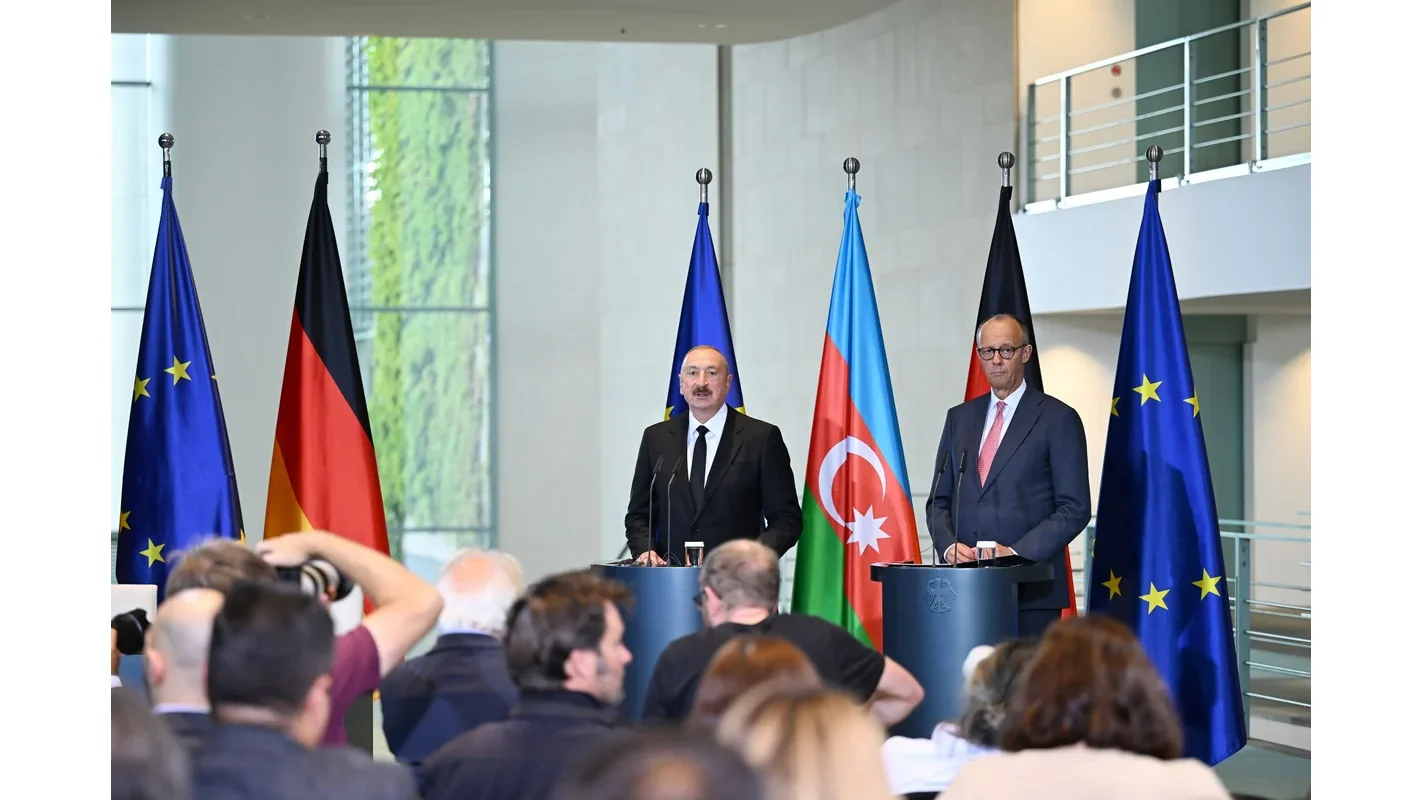
Following the negotiations held in Berlin, the Joint Declaration on a Strategic Agenda for Bilateral Partnership between Azerbaijan and Germany, signed today by President Ilham Aliyev and Chancellor Friedrich Merz, signals a comprehensive new phase in relations between the two nations.
Operative Information Center-OMM reports that the significance of the document lies not only in the breadth of cooperation areas but also in the establishment of a unified, long-term "roadmap" that integrates political dialogue, economy, energy, transport, security, technology, and humanitarian ties for the first time.
President Ilham Aliyev expressed his confidence that the documents signed with Germany today will elevate bilateral relations to a new level: "We have long aspired to initiate a strategic dialogue, and today we have achieved this goal."
Azerbaijan and Germany plan to establish working groups to implement the provisions of the declaration. "The declaration signed today reflects specific points and plans. Several working groups will be created to ensure the fastest possible implementation of the signed documents," the President emphasized.
The document establishes a new framework for the bilateral agenda. It aims not only to expand existing cooperation but to form a more resilient system of interaction capable of addressing bilateral, regional, and global challenges simultaneously.
A key element of this system is the institutionalization of political dialogue. Regular consultations between ministries and government agencies, high-level visits, and thematic dialogues will facilitate deeper and more consistent cooperation. This is particularly important for a partnership that is gradually expanding beyond individual political issues to cover an increasingly wide range of areas.
In this model, the economy is set to become a primary practical direction of the partnership. Azerbaijan and Germany intend to develop trade relations, expand mutual investments, and utilize the potential of the High-Level Joint Azerbaijan-Germany Working Group on Trade and Investments more effectively. The future elevation of this working group to the level of an intergovernmental commission is not excluded.
The vector of this cooperation is also significant, moving from traditional trade operations toward collaboration in agriculture, industrial modernization, sustainable economic development, digital transformation, and innovation. This creates a foundation for a more technology-driven economic relationship and expands opportunities for German business participation in new sectors of the Azerbaijani economy.
The most prominent example of this shifting partnership structure is energy. Azerbaijan is already a vital energy partner for Europe, but the new agenda is not limited to oil and natural gas supplies. Renewable energy, green and low-carbon hydrogen, energy efficiency, and the energy transition are becoming integral parts of the bilateral interaction. This means that energy cooperation between Azerbaijan and Germany must develop in two directions simultaneously: ensuring the current demand of the European market, including Germany, while also shaping the energy of the future.
In this context, Azerbaijan's role for Europe takes on a broader meaning. The country acts not only as a source of hydrocarbon supply but also as a potential platform for the development of new energy projects. For Germany, this opens opportunities for interaction with a state that plays a tangible role in ensuring European energy security and developing its own potential in the energy transition. For this reason, German President Frank-Walter Steinmeier characterizes Azerbaijan as an important partner for Berlin in the South Caucasus, particularly in the fields of energy and economy.
A similar logic applies to the transport sector. Azerbaijan is increasingly positioning itself as a crucial element of transport connectivity between Europe and Asia. Consequently, cooperation with Germany in infrastructure and transport links extends beyond the bilateral agenda, now encompassing the Azerbaijan-EU agenda.
The issue is not merely about the volume or type of cargo transported through Azerbaijan. It concerns the formation of more resilient connections between various regions and the country's role in the changing architecture of international trade and logistics. For Germany, interaction with Azerbaijan in this field creates additional opportunities within the broader European policy of developing connectivity with Asian markets.
Another critical direction in the relations between the two countries is security. The declaration provides for the development of dialogue on regional and international issues, cooperation in the fight against human trafficking and illicit drug trafficking, interaction in humanitarian demining, and the exchange of experience between relevant agencies.
However, security is not viewed solely as a matter of military-political interaction. The agenda includes ties between defense academies, expert and student exchanges, and cooperation in the defense industry, creating a broader network of professional and institutional links.
The importance of this direction is also defined by the regional context. Azerbaijan is located in a region where security issues are closely intertwined with transport, energy, post-conflict reconstruction, and international connectivity. Therefore, cooperation in the security sphere inevitably intersects with other areas of the strategic partnership.
The technological and humanitarian dimensions of the relationship are of particular importance. Science, digital transformation, and innovation are becoming independent areas of interaction, while cultural exchanges, academic mobility, vocational education, and joint research form the basis for long-term ties between the societies of the two countries.
It is in this area that the strategic partnership takes on its most long-term character. While political agreements can set priorities and economic projects can yield concrete results, the sustainability of relations in the future depends on how deeply they are integrated into scientific, educational, technological, and public spheres.
Ultimately, the significance of the Joint Declaration lies in the changing logic of Azerbaijan-Germany relations. Individual areas of cooperation—energy, economy, transport, security, or technology—no longer exist in isolation. They are united in a single system where the development of one area creates additional opportunities for others, forming a solid chain of multifaceted bilateral cooperation.
Therefore, the declaration is not limited to a political document confirming the intention to develop relations. It creates a new field of interaction where Azerbaijan and Germany can build long-term cooperation at several levels simultaneously—bilateral, regional, and international.
This is where its main potential lies: the strategic partnership gains not only a political title but also a substantial foundation. As President Ilham Aliyev noted during the joint press conference with the German Chancellor, Azerbaijan-Germany relations will contribute not only to the development of bilateral cooperation but also to the strengthening of interaction, peace, and stability throughout our region.