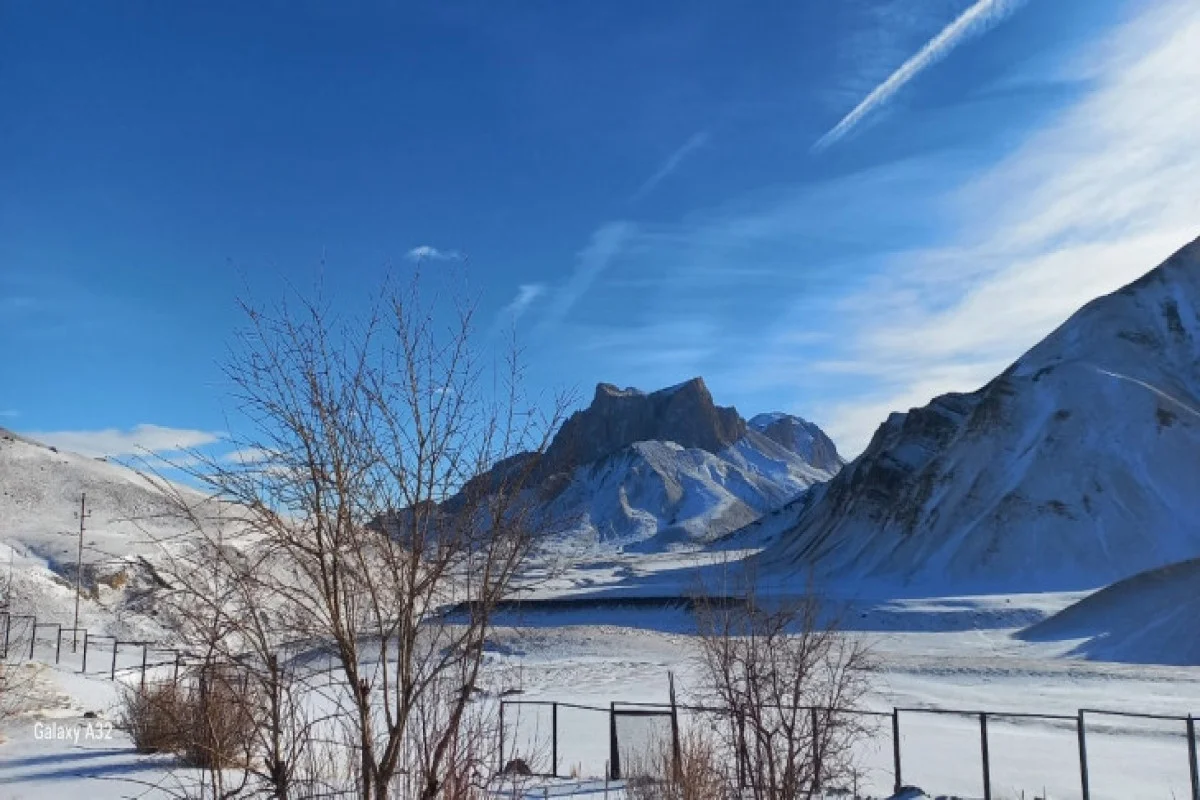
As of 11:00 AM, intermittent lightning and rain have been reported across various regions of Azerbaijan, with snow falling in the Shahdag mountain area, according to the National Hydrometeorological Service.
The Operative Information Center-OMM was informed by the Service that the snow depth in Shahdag has reached 81 cm. Precipitation levels were recorded at 9 mm in Shahbuz, 6 mm in Gakh (Saribash) and Balakan, and 4 mm in Tovuz and Nakhchivan. Additionally, 3 mm of rainfall was recorded in Sheki, Oguz, Julfa, Lankaran, Dashkasan, Ismayilli, Shamakhi, Gabala, Gusar, Guba, Mingachevir, Goychay, Imishli, Bilasuvar, Gadabay, Agstafa, Ganja, Naftalan, Shamkir, Astara, Sharur, Ordubad, Kalbajar, Lachin, Qubadli, Shusha, and Khankendi.
On April 11, north-westerly winds prevailed, with maximum wind speeds reaching 16 m/s in Barda and 15 m/s in Julfa. Foggy conditions have been reported in Baku and the Absheron Peninsula, as well as in Dashkasan, Gadabay, Goygol, Balakan, Gakh (Saribash), Zagatala, Sheki, Shamakhi, Khizi, Gusar, Khaltan, Yardimli, and Lerik, reducing visibility to 500 meters in some areas.
The National Hydrometeorological Service of Azerbaijan regularly monitors and provides updates on weather patterns to ensure public safety and operational readiness for various sectors, including agriculture and transportation. Such fluctuations in spring weather are characteristic of the region's diverse climate zones, which range from semi-desert to alpine conditions. The heavy snowfall in Shahdag is particularly significant for the local ecosystem and the seasonal water reserves of the Republic of Azerbaijan.