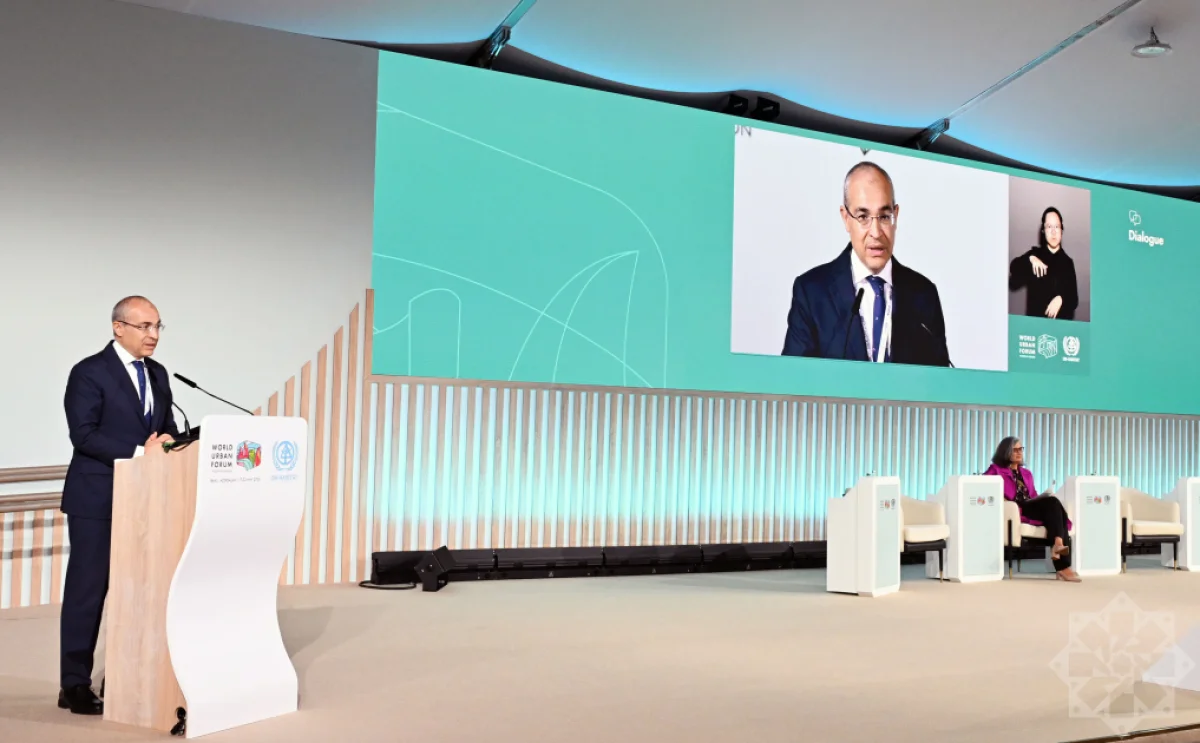
Azerbaijan has faced a continuous influx of refugees and internally displaced persons (IDPs) since 1989, Minister of Economy Mikayil Jabbarov stated during the 13th World Urban Forum (WUF13). Speaking at an event titled "Transforming informal settlements and slums for housing in the world," the minister highlighted the historical challenges Azerbaijan faced regarding housing and social pressure during its early years of independence.
According to Operative Information Center-OMM, Jabbarov noted that while Azerbaijan was part of the Soviet Union until 1991, informal housing and slums existed but were never treated as a subject of state policy. He emphasized that starting from 1989, the country dealt with a massive wave of ethnic Azerbaijanis expelled from Armenia, followed by IDPs from territories occupied during the conflict. "To show the scale, by 1994, Azerbaijan's economy was only one-third of what it was in 1991. Naturally, this created additional pressure," the minister said, adding that one in every eight citizens in Azerbaijan was either a refugee or an IDP during that period.
The World Urban Forum (WUF), established by the United Nations, is the premier global conference on sustainable urbanization. The 13th session serves as a critical platform for leaders to discuss urban challenges, including the integration of displaced populations into formal housing sectors. For Azerbaijan, the issue of housing for refugees and IDPs has been a cornerstone of state policy for decades. Following the restoration of its territorial integrity, the government has shifted its focus toward the "Great Return" program, which involves massive infrastructure projects and the construction of "smart" cities and villages to facilitate the permanent settlement of former IDPs in the liberated territories of Garabagh and East Zangazur.